
Depuis des décennies, les services de développement commercial dans l'agroalimentaire suivent un schéma bien rodé : formations gratuites dispensées à tous ceux qui se présentent, résultats mesurés en effectifs et financements de donateurs qui maintiennent artificiellement le système en vie. Cela ressemble à du soutien, mais cela fonctionne comme un substitut au marché.
Lorsque les services sont gratuits, ils n'ont aucune valeur. Les prestataires sont peu incités à fournir un service de qualité. Les entreprises ont peu de raisons de s'y impliquer sérieusement. Et lorsque le donateur se retire, le marché qui était censé exister disparaît tout simplement.
Les enquêtes BDS menées par l'AMEA entre 2023 et 2025 ont confirmé ce dysfonctionnement dans de nombreux pays. La question n'était pas de savoir si le marché était défaillant, mais s'il était possible de le réparer et, le cas échéant, comment.
Le projet pilote de partage des coûts de l'AMEA, financé par l'AGRA, visait à tester une alternative structurelle. Au lieu de subventionner intégralement les services, le projet pilote demandait aux entreprises de co-investir – à hauteur d'au moins 201 000 milliards de dollars des coûts de service – et conditionnait la rémunération des prestataires à des résultats vérifiés.
Lors de la première phase, six des principaux fournisseurs de services aux entreprises en Ouganda ont proposé leurs services à 24 PME agricoles, avec des forfaits de services individuels d'une valeur maximale de 1 TP4 000 à 2 500 yuans. La conception s'appuyait sur une étude d'ISF Advisors démontrant qu'une participation financière moyenne de 171 TP3 000 yuans suffisait à garantir l'implication réelle des entreprises et que cela améliorait sensiblement les résultats.
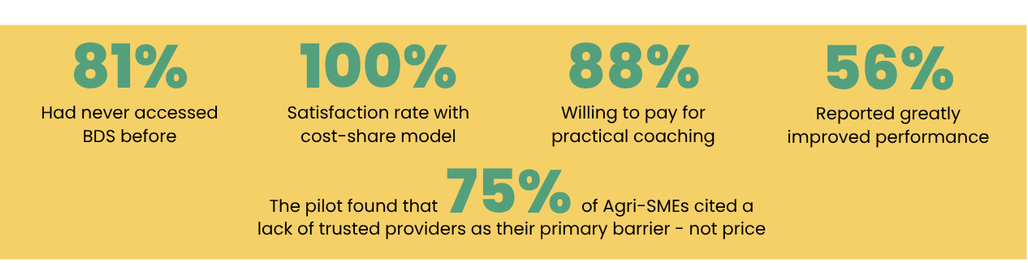
Les résultats sont sans équivoque. Parmi les entreprises participantes, 811 n'avaient jamais eu recours à un service de conseil en stratégie commerciale auparavant. 881 se sont déclarées prêtes à payer pour un accompagnement pratique. Le taux de satisfaction à l'égard du modèle de partage des coûts a atteint 1 001. Enfin, 561 entreprises ont constaté une nette amélioration de leurs performances.
Le constat le plus révélateur est peut-être que 751 PME agricoles interrogées dans le cadre du programme TP3T ont cité le manque de prestataires de confiance comme principal obstacle, et non le coût des services. Ceci remet en question une hypothèse récurrente dans la conception des programmes, selon laquelle le prix serait le principal frein à l'adoption des services de développement commercial.
Le projet pilote a permis de dresser un tableau détaillé de ce qui fait le succès du partage des coûts en pratique – et de ce qui le compromet.
Pour les fournisseurs de BDS, les principaux changements sont les honoraires liés aux résultats (subventions versées en deux tranches, la 50% étant conditionnée à une amélioration vérifiée de l'entreprise), les droits de sélection des clients et le passage d'une prestation transactionnelle à des relations clients durables.
Pour les PME agricoles, même une simple contribution financière (en espèces ou en nature) au titre du programme 10% change la donne. Les entreprises participent, s'impliquent et mettent en pratique leurs acquis. Les principaux besoins en services identifiés lors des évaluations diagnostiques concernaient la planification d'entreprise (94%), la tenue de registres (81%) et l'accès au financement (75%), ce qui confirme que le soutien pratique et axé sur les résultats commerciaux stimule la demande.
La première phase a également mis en évidence qu'une approche unique ne peut convenir à toutes les entreprises de manière égale. Une coopérative de 30 petits exploitants agricoles et une entreprise agroalimentaire établie depuis dix ans sont confrontées à des contraintes fondamentalement différentes. Un taux de cofinancement uniforme est à la fois inéquitable et inefficace.
Le nouveau document de synthèse de la LIA propose un cadre de segmentation à trois niveaux – émergent, en croissance et établi – avec des taux de cofinancement allant de 10 à 200 TP3T pour les coopératives en phase de démarrage à 50 à 600 TP3T pour les entreprises agroalimentaires commerciales. Point essentiel, 441 TP3T des participants au projet pilote ont préféré des modalités de cofinancement en nature, une flexibilité que le cadre prend en compte.
Quatre principes de conception complètent ces recommandations : évaluer avant d’allouer ; privilégier la relation à la transaction ; considérer la bancabilité comme un objectif prioritaire ; et concevoir une solution hybride fonctionnant dans des environnements à faible connectivité.
Cet apprentissage alimente directement l'événement annuel d'apprentissage de l'AMEA 2026, qui se déroulera virtuellement les 23 et 24 juin, de 14h00 à 16h30 CEST.
La deuxième journée, consacrée à la mise à l'échelle des meilleures pratiques en matière de BDS, comprend une session dédiée : “ Les mécanismes de partage des coûts du BDS : les PME paieront-elles pour le BDS ? ” – une extension directe des conclusions de ce projet pilote à un débat plus large.
Les autres sessions du deuxième jour portent sur la transformation des marchés BDS grâce à l'assurance qualité, la mesure de la rentabilité des BDS, l'initiative des 10 000 FPO en Inde et les approches pour impliquer les jeunes.
Inscrivez-vous dès maintenant sur www.amea-global.com/ale26.
Lisez le document d'information complet LIA-LB-01, qui fait partie de la série « Apprendre en action » de l'AMEA, qui documente et analyse les approches BDS de l'ensemble du réseau AMEA afin de constituer une base de données probantes partagée pour le secteur.
Nous utilisons des cookies sur notre site web pour vous offrir une expérience optimale en mémorisant vos préférences et vos visites répétées. En cliquant sur « Accepter tout », vous consentez à l'utilisation de tous les cookies. Vous pouvez toutefois accéder aux « Paramètres des cookies » pour exercer votre consentement.