
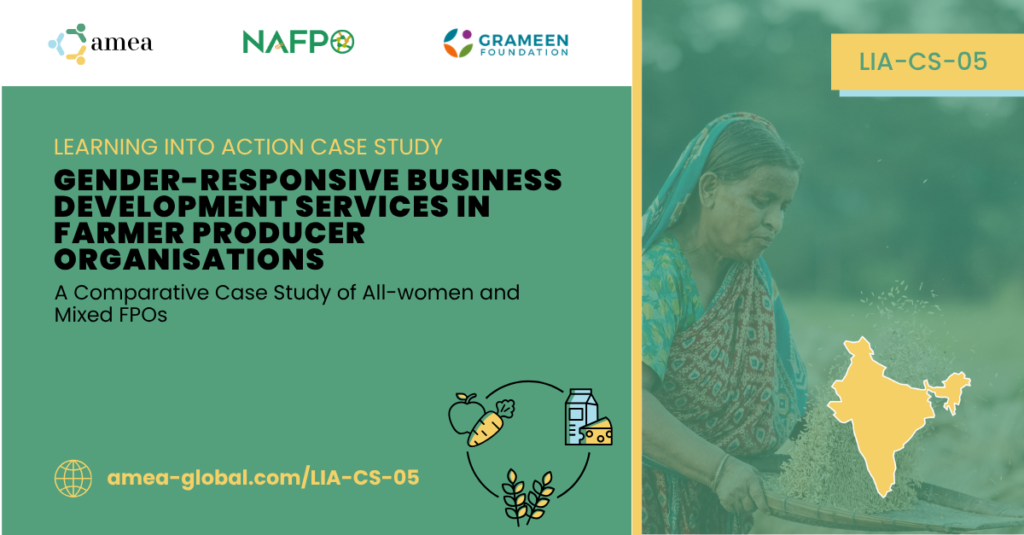
India has over 44,000 registered Farmer Producer Organisations (FPOs) – member-owned companies that help smallholder farmers collectively access markets, inputs, and services. Of the 10,000+ established under government schemes, they now connect 3 million farmers, 40% of whom are women.
But not all FPOs are built the same. And the Business Development Services (BDS) that support them shouldn’t be either.
A new case study developed under AMEA’s Learning into Action agenda takes a closer look at how BDS design shapes outcomes depending on FPO gender composition – comparing 10 all-women FPOs with 19 mixed-gender FPOs across India, representing a combined membership of 27,000 farmers.
Neither model is universally superior. The right approach depends on what a programme is trying to achieve.
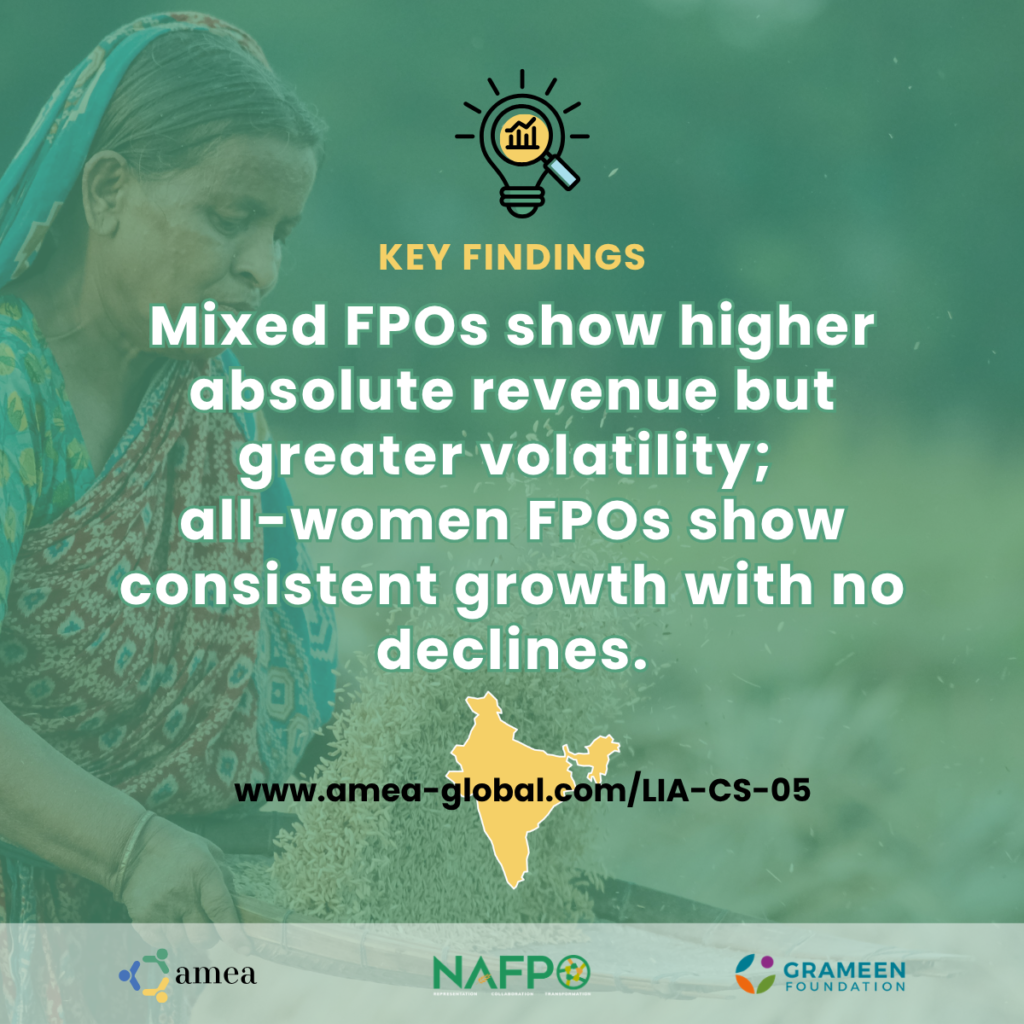
All-women FPOs deliver steadier, more stable growth – built on strong governance foundations. Mixed-gender FPOs scale faster commercially, but with greater volatility and risk.
The study found that all-women FPOs aggregate members 56% faster than mixed FPOs of the same age, drawing on pre-existing Self-Help Group networks that bring ready-made trust, financial literacy, and collective decision-making experience. They also recorded 0% revenue decline across the sample period, compared to 37% of mixed FPOs experiencing at least one year of revenue decline.
Mixed-gender FPOs, meanwhile, generate roughly twice the revenue at comparable ages and demonstrate a 195% ROI on BDS investment. However, they show a significant growth plateau at 7+ years – with average revenue dropping 56% – suggesting that sustained BDS engagement beyond the initial support period is critical.
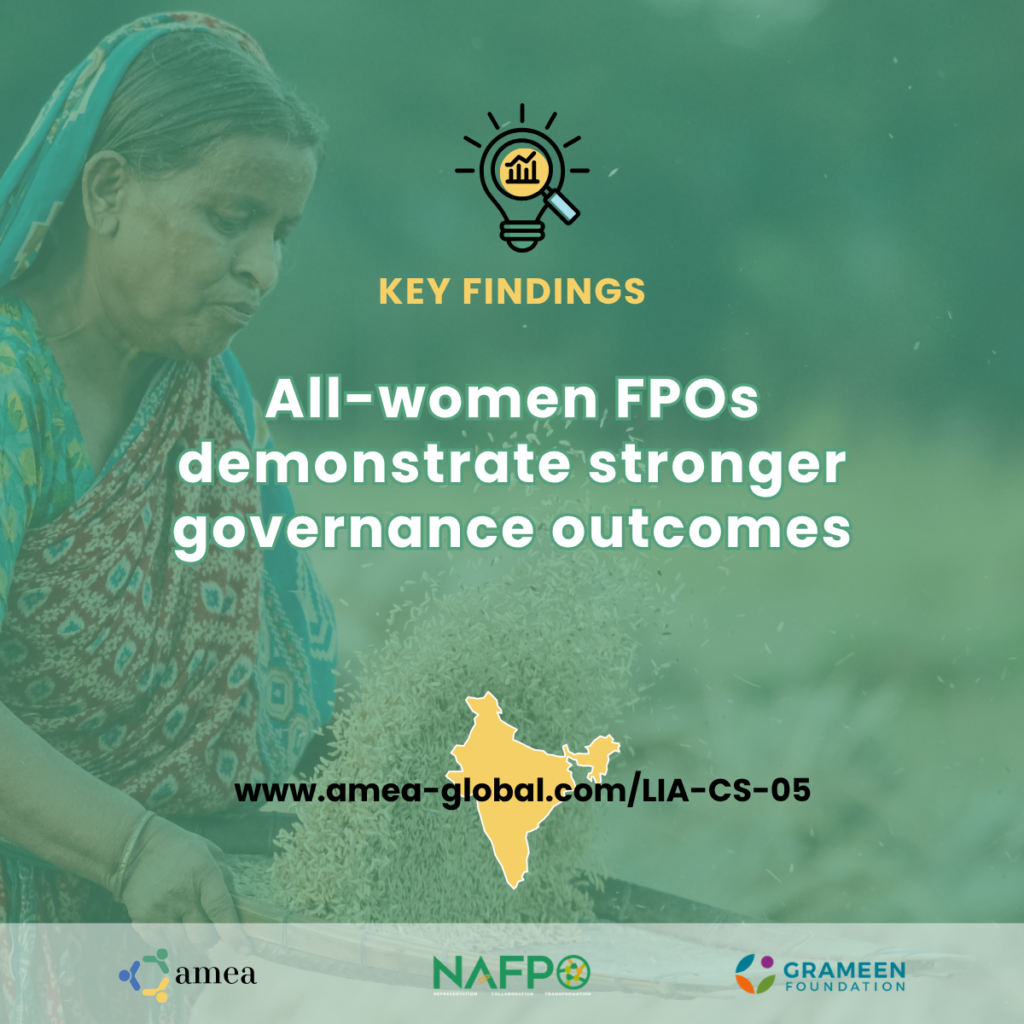
One of the study’s most striking findings is on governance. Every all-women FPO in the sample held board meetings as mandated, with 100% reporting women board members attending more than 75% of meetings, and 100% making decisions by consensus. In mixed FPOs, board attendance was variable and CEO influence over decision-making was notably higher.
This matters for programme design. Where genuine inclusion of women farmers in leadership and decision-making is a priority, all-women FPO structures offer a more effective institutional pathway than mixed FPOs, where women’s participation can remain limited despite numerical representation.
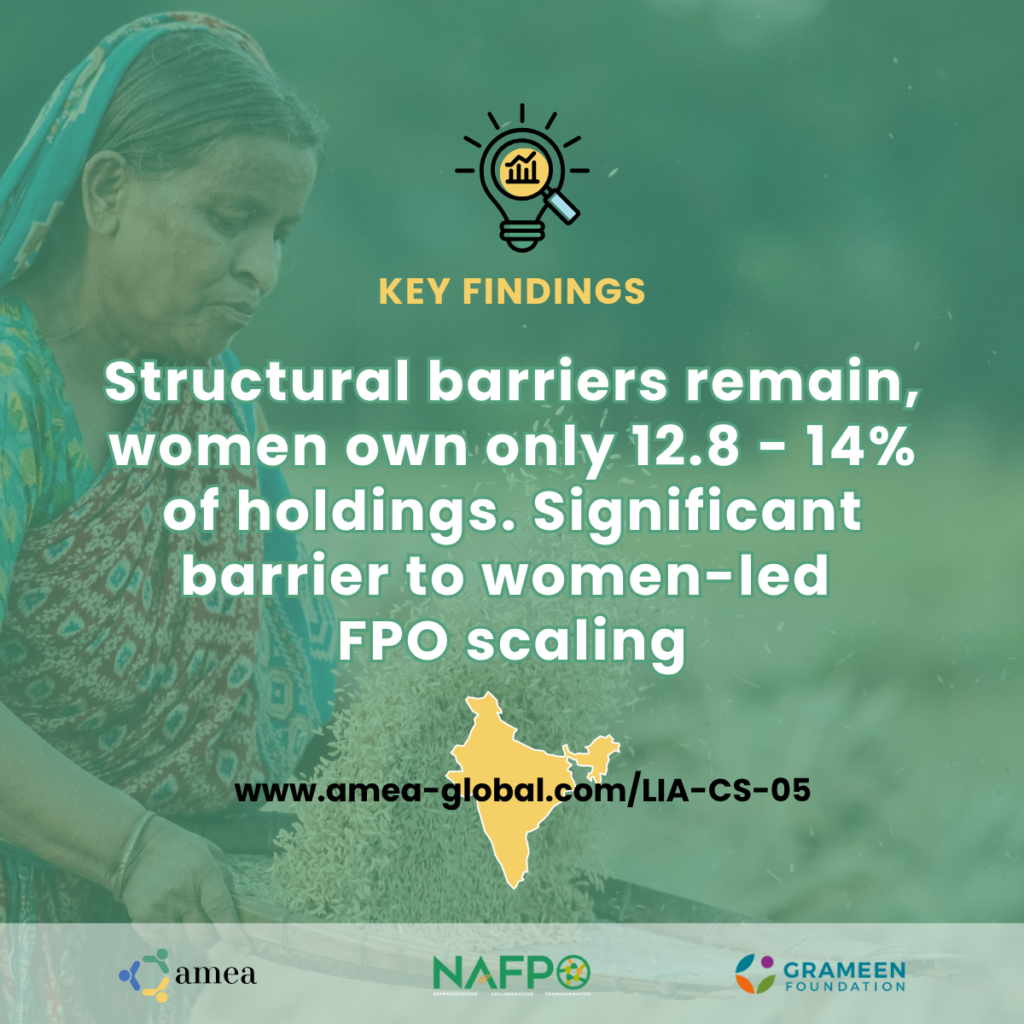
The study also surfaces a significant systemic challenge: women own only 12.8–14% of agricultural land holdings in India. Since farmer certification for FPO registration typically requires land ownership documentation, this creates a structural barrier that excludes the majority of women farmers — who work as tenant farmers or on family land not registered in their names. These are not issues BDS alone can resolve. They require policy-level solutions.
The study points to two distinct BDS approaches:
The recommendation is not to choose one over the other, but to sequence and design BDS according to the composition and maturity of the FPO being supported.
BDS costs for mixed FPOs ran at approximately 2.5 million rupees (~$30,500) per FPO over 18–24 months. While the ROI is positive, the study notes that costs at this level may limit further scaling — and recommends that BDS providers be supported to experiment with more cost-effective approaches.
We use cookies on our website to give you the most relevant experience by remembering your preferences and repeat visits. By clicking “Accept All”, you consent to the use of ALL the cookies. However, you may visit "Cookie Settings" to provide a controlled consent.